Table of contents
Starting your denture journey: what to expect in the first few days
It’s finally happened - you’ve had your teeth extracted. Whether you made the decision for health or aesthetic reasons, now you’re adjusting to a whole new way of being - one where dentures replace your natural teeth. It can feel daunting. Perhaps you feel relief, but there are also feelings of apprehension. What will change, how will you manage? One of the biggest uncertainties is how to insert and remove full dentures when your mouth is still healing from extractions. When you master this function, your confidence will grow and transitioning won’t seem so overwhelming.
The first thing to remember is there are hundreds of thousands who’ve made a successful transition before you. The second thing to remember is adapting to your new reality is a learning curve, not a quick fix. While your dental professional has given you clinical guidance, what follows are practical tips and insights from denture wearers who've lived this experience – and come out the other side.
The emotional shock of losing your natural teeth
Even having been briefed by your dental professionals about what to expect after tooth extraction and replacement with a denture, it can still come as a shock. Losing a part of you can release a tide of emotions. Shock because looking in the mirror after having all your teeth removed can prompt a shift in sensory feedback. It doesn’t look or feel like ‘you’. Regret because it cannot be undone - no more natural teeth. Relief because you have no more pain, infections, unsightliness, or loss of function. These are natural reactions.
Physical changes after extractions and immediate dentures
The physical aftermath can be equally confronting. If you’ve had immediate dentures fitted directly after your tooth extractions, you will experience swelling and possibly some tenderness or pain. For the first day or so, your mouth will taste awful and you may constantly have to mop up bloody drool. You may wonder why your denture feels too big, or too tight. If your dentures were fitted sometime after your mouth had healed from the extractions, in addition to these things, the denture may also seem too loose.
Remember the ‘first thing’ mentioned earlier? Getting used to dentures is a gradual adjustment not an instant fix. Setting this expectation helps you endure the short-term discomfort knowing there will be long term gain.
Tip: Where possible focus on short wear periods and gradual adjustment. It’s recommended immediate dentures are not removed for the first 24 to 48 hours. They act as a ‘surgical bandage’ to control swelling, protect the extraction sites, and minimise bleeding.
How to insert and remove full dentures
Inserting your new dentures when your mouth is tender evokes all kinds of resistance. Will it hurt? What if you can’t bear it? Well, take a deep breath and trust the process. Anxiety is not your friend, so try to relax. There is a way to do this to minimise discomfort.
How to insert full dentures (step-by-step)
- Firstly, prepare your space. A mirror so you can see what you’re doing. Ideally over a sink. Place a folded towel in the sink in case the denture slips from your grasp.
- Wash your hands and wet the denture to allow it to slip more easily into place.
- Breathe through your nose while performing the exercise.
- Insert the top denture first
- Hold the denture at an angle between the fingers and thumbs of both hands – back tilted upwards. Place into your mouth and roll the front upwards into position. Push gently to secure.
- Now with fingers and thumbs of both hands grasp the bottom denture with the back tilted slightly downward.
- Place into your mouth and roll down until the front connects with your gums. Push gently to secure.
Tip: Don’t bite down hard to seat the dentures. This can be harmful to both your gums and the denture.
Tip: Don't attempt this when you're in a hurry or stressed, as tension in your jaw muscles makes the process harder.
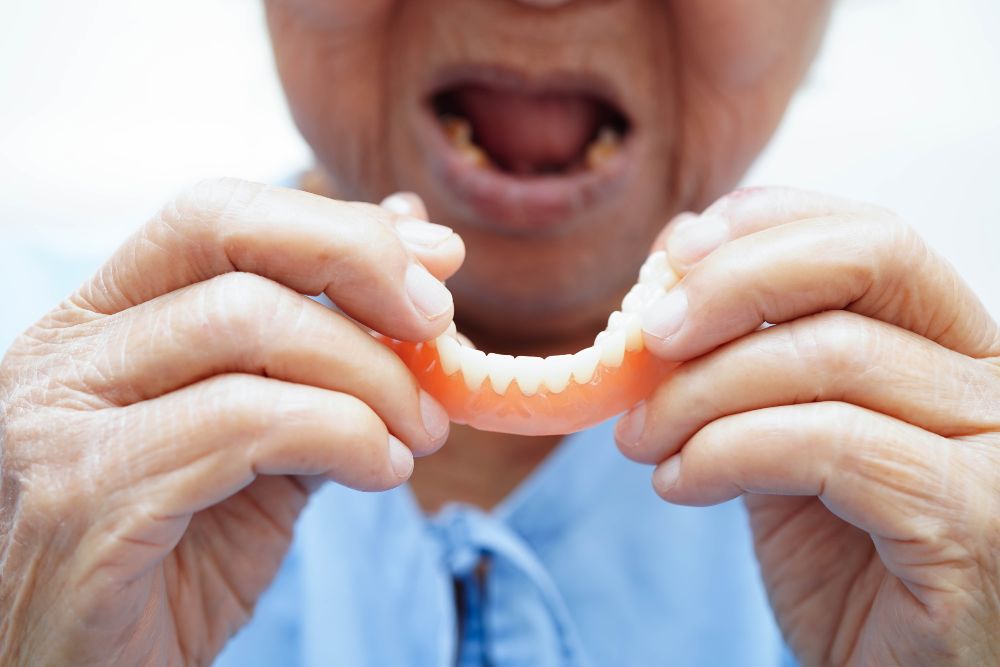
How to remove full dentures (step-by-step)
Removing your dentures involves a different technique from insertion.
Lower denture
- Swish warm water in your mouth and puff your cheeks to loosen the seal.
- Remove the bottom denture first by placing your thumbs either side of the bottom edge.
- Using your pointer fingers and thumbs to grab the front of the denture and push up and out.
Upper denture
- Place your index fingers over the edge of each side of the denture toward the back, near your cheek. Rest your thumbs against the edge of the teeth. Now pull down with a gentle rocking motion to break the seal. The seal is strongest at the front.
Tip: A common fear among denture wearers is “They’re stuck forever.” If this happens to you, take a deep breath and avoid using force. Otherwise, you risk damaging your dentures and injuring your mouth.
Tip: If it feels impossible at first, take time out and try again in a little while. It’s normal for nerves or tenderness to take over.
The “Tilt and Tuck” technique denture wearers swear by
Eventually, you will develop your own best practice for inserting and removing your dentures. You will perform the task smoothly without even a second thought. It’s simply a matter of practise, and in the meantime, your confidence will grow, and those feelings of panic will recede. You may like to experiment with the following insertion method recommended by many denture wearers.
Tilt
This involves inserting the denture into your mouth at a slight downward angle for the upper denture, or upward angle for the lower denture, rather than pushing it straight up or down.
Tuck
Gently push the back portion of the denture up (or down for the top arch) to lock the back into place against your gums. Then rotate the front of the denture down for the lower denture, or up for the upper denture until it rests flush against your gums.
Seat and swallow
Push the front of the denture firmly onto your gums and swallow, creating a natural vacuum seal.
Tip: If you struggle to get suction, use a small amount of denture adhesive to create a strong seal.
Tip: For those with arthritic fingers or no fingernails to get sufficient purchase on the edge of the denture, there are small plastic hooks you can buy made for the purpose.
Tip: Watch a few YouTube videos on how other denture wearers do it. Seeing someone else perform the action can make it easier to replicate.

Why your dentures feel so big
This feeling is a normal case of sensory overload, but have faith, you will adapt. It happens because your brain struggles to process the exact dimensions of the denture, making it feel like a foreign, oversized object. The brain maps the mouth with extreme precision. The sudden addition of a rigid dental appliance—required to properly support your lips and prevent slippage—overwhelms your tongue and sensory nerves. However, eventually your speech adjusts and your tongue learns to reposition and accommodate what initially feels like an enormous intrusion. Most people adjust within 30 days.i
Wearer insight: “they didn’t shrink—my brain adjusted.”
The saliva situation: too much, too little, just weird
So, you have your new dentures, but why are you drooling like a Labrador? Uncomfortable, yes - however, it’s just a temporary response to what your body perceives as a foreign object, causing your salivary glands to go into overdrive.ii You can expect the salivary tide to peak in the first 24 to 48 hours, after which it will reduce as your mouth adapts, stabilising after 1 to 3 weeks.
Tip: Frequent sips of water make swallowing the excess saliva easier.
Tip: Try to swallow the excess rather than spitting it out because this will help train your body.
Tip: Be patient, allow time for your mouth to adjust - because it most certainly will.
Tip: Avoid spicy, sour or acidic foods in the interim, which tend to stimulate excessive saliva flow
The emotional tunnel of adjusting to full dentures
Make no mistake, making the transition from loss of your natural teeth to acquiring dentures should not be underestimated, not only in physiological terms but also in psychological adjustment. Psychologists describe this emotional process as the 'Emotional Tunnel’.iii It begins with shock and grief over the loss of your natural teeth, moves toward trust in your new dentures, and ultimately arrives at acceptance. How successful you are at navigating this relies heavily on your attitude and having realistic expectations. [For more information see Getting Used To New Dentures]
Reflecting on the emotional side of new dentures
Let's be honest – the first days with dentures can be confronting. When you first perceive yourself wearing a denture, it can feel overwhelming. You feel self-conscious when you look in the mirror or embarrassed in social situations. Your face looks different, your mouth feels different, and there's genuine grief in losing your natural teeth. It's completely understandable if you want to hide away while you adjust. Try to remember that while you’re grieving the old ‘you’, the new ‘you’ is waiting in the wings to make a grand entrance.
The turning point: when dentures start to feel normal
But here's the encouraging news: once you get past the initial physical adjustment something shifts. You become more adept at inserting and removing your dentures, which gives you a real confidence boost in all areas. Around the 30-day mark, your mouth adapts, and you’re speaking and eating more easily, and you can feel your confidence bloom. You begin to recognise your facial proportions as your own and you no longer smile behind your hand or with closed lips. Your smile appears spontaneously with a welcome lack of self-consciousness. And that crushing social anxiety? Already on its way out the door. Your psychological wellbeing improves along with your physical comfort. [For more information see Will My Dentures Ever Feel Normal]
What helps you succeed with full dentures
Your attitude genuinely matters. Studies show that people who stay positive and work cooperatively with their prosthetist adjust much faster than those who approach dentures with anxiety or negativity. Equally important are your expectations. Dentures aren't natural teeth – they work differently, feel different, and have different limitations. Understanding and accepting this from the start leads to far greater satisfaction long-term. It's not about settling for less; it's about appreciating what dentures can do rather than focusing on what they can't.iv
Tip: Be kind to yourself and allow yourself the time to transition.
Tip: Practise smiling in front of the mirror, it will help your face become familiar again and break the old habit of hiding your smile.
Tip: Remind yourself it will only get easier and give yourself credit for making progress.
Tip: Let yourself entertain the possibility of an even ‘better’ you.
Learning to know what’s normal with full dentures
You’ve never been in this situation before so how do you tell between what is normal for a new denture and when you need to seek help or adjustments? The practical answer is to pay attention to the pattern of your discomfort. If your discomfort decreases over a few days, then this indicates normal adjustment. If, however, the pain persists, worsens, or interferes with day-to-day functioning, then you need to seek help from your prosthetist.
What’s normal
Expect your discomfort to peak in the first 24 - 48 hours after having your denture fitted or after an adjustment. The discomfort should decrease over the next 3–7 days. It is normal for your saliva to be blood-tinged for the first 24 –72 hours. Normal function can be expected in 2–3 months, during which time adjustments to your denture’s fit may be needed.
When to seek help from your prosthetist
If your discomfort gets steadily worse rather than better, it’s time to seek help.
Red flags to watch for:
- Pain persisting beyond a week
- Persistent difficulty inserting or removing your denture
- Excessive pressure
- Gaps or poor seating of your denture
- Pain that interferes with eating or speaking
- Sore spots that don’t improve
- Excessive bleeding that doesn’t respond to pressure
- Any signs of infection
Tip: Keep note of your progress trend rather than a single bad moment. For example, if the denture is uncomfortable every time you wear it rather than just during the first few days.
Tip: No-one expects you to ‘tough it out’. If you have any concerns at all, don’t delay calling your denture clinic for reassurance and advice. Denture success is their business. They want you to feel, and be safe, rather than stressed or sorry.
[For more information see Why do my dentures hurt]
Insight from the seasoned full denture wearers
Experienced denture wearers share what they wished they’d known earlier:
- Adapting to dentures gets easier with time and practise
- There will be setbacks, but each one is an opportunity to learn and adjust
- Denture adjustments are part of the normal process
- Most people don’t notice the things you fear most.
- Persistence pays off
- Gradual exposure builds confidence
Final words
Nobody navigates the denture journey in exactly the same way. But trust us, you will find your own path. Patience and self-compassion are your most valuable tools right now, alongside realistic expectations and a willingness to learn. Learning to insert and remove full dentures is a process, not a ‘set and forget’ exercise. Remember, confidence builds gradually, one small win at a time. Protect your long-term comfort with regular denture reviews and relines as your mouth changes. And on the days it feels hard, remind yourself that on the other side of this adjustment period is a person who smiles freely, eats comfortably, and barely gives their dentures a second thought. That person is you – and you're closer than you think.
References
[i] Topić J, Poljak-Guberina R, Persic-Kirsic S, Kovacic I, Petricevic N, Popovac A, Čelebić A. Adaptation to New Dentures and 5 Years of Clinical Use: A Comparison between Complete Denture and Mini-implant Mandibular Overdenture Patients based on Oral Health-Related Quality of Life (OHRQoL) and Orofacial Esthetics. Acta Stomatol Croat. 2022 Jun;56(2):132-142. doi: 10.15644/asc56/2/4. PMID: 35821720; PMCID: PMC9262111.
[ii] Wolff A, Ofer S, Raviv M, Helft M, Cardash HS. The flow rate of whole and submandibular/sublingual gland saliva in patients receiving replacement complete dentures. J Oral Rehabil. 2004 Apr;31(4):340-3. doi: 10.1046/j.1365-2842.2003.01247.x. PMID: 15089939.
[iii] https://www.sciencedirect.com/science/article/pii/S0300571224001349#sec0012
[iv] https://www.sciencedirect.com/science/article/pii/S0300571224001349
About Northern Rivers Denture Clinic
Northern Rivers Denture Clinic is a specialist denture practice based in Tweed Heads, NSW. Our team of qualified dental prosthetists has decades of combined clinical experience helping patients navigate their options for missing or failing teeth. We believe good decisions start with good information, and we're happy to talk through your situation with no pressure and no obligation. If you'd like an honest, personalised assessment, we offer a free consultation to get you started.
Disclaimer – Always consult your oral health professional for expert advice about your unique personal situation. The information given here is of a general nature and for the purpose of education only. It is not meant to replace the advice of your oral health professional.